As I mentioned at the end of last year, we’ve now managed to find the funds to make further changes to the site and 1APP service, carrying on the programme of improvement.
One of the key changes will be the e-enablement of the Non Material Amendments form. (The form is currently available from the Portal but only as a PDF.) I’m sure this will come as good news to many!
We’re also making a couple of other changes to the service.
The first is to comply with new policy from DCLG on streamlining information requirements for planning applications.
Specifically we’re making improvements to merge the certificates section of the forms that will ensure the Agricultural Land Declaration certificate is always completed. It might seem a minor change but our service desk gets dozens of calls a month about this and it’s one of the main reasons local authorities invalidate paper applications as it’s often not completed.
Secondly, we’re making some changes to the tool that helps applicants choose forms, we call it the “Form Chooser”, and also to the way applications are started. Read more…
I saw this and couldn’t help but bring it to your attention.
Designed by Italian architect firm Boeri Studio Stefano Boeri, Gianandrea Barreca and Giovanni La Varra and being constructed in design capital Milan.
The first example of a Bosco Verticale composed of two residential towers of 110 and 76 metres height, will be realised in the centre of Milan, on the edge of the Isola neighbourhood and will host 900 trees (each measuring three, six or nine metres tall) apart from a wide range of shrubs and floral plants.
According to the architects website, on flat land each Bosco Verticale equals, in the amount of trees, an area equal to 10,000sqm of forest.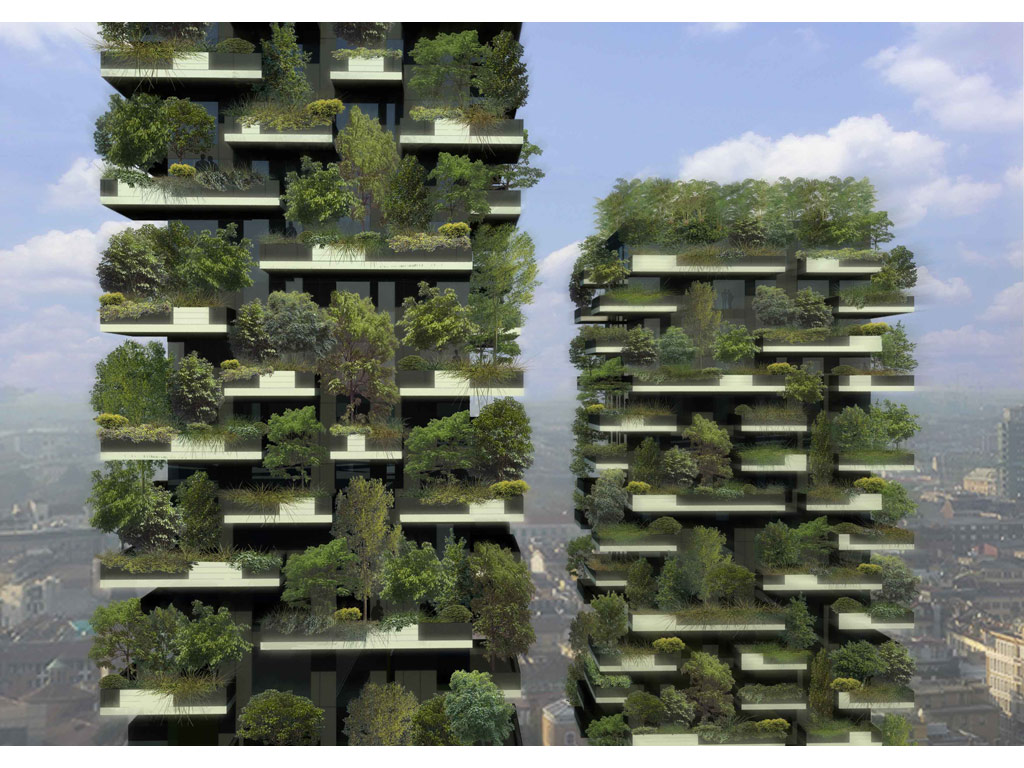
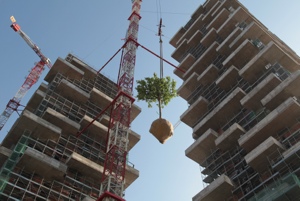
This story has caused so much interest I thought I would update it with another image lifted from the architect’s own website where more images can be found.
The pictures clearly shows building well underway and trees being hoisted into position.
It is worth pointing out that the architect Stefano Boeri has a well-respected body of work.
RESPONSE FROM LAURA GATTI – LANDSCAPE CONSULTANT ON BOSCO VERTICALE
The following is an excerpt from Laura’s response via LinkedIn to some of the questions raised.
Milano is not such a windy city, fortunately. By the way, we have calculated with two different steps held in two wind galleries (Milano and Miami) forces acting on trees, on the building and transferred by the trees to the building. With the help of prof. Ruck from Freiburg University (Germany) we calculated forces acting on trees, then forces helped us to define a right dimensioning of the trees.
Trees will be maintained by a single company because they are not ‘private’ trees, the ‘pots’ are properties of all the owners.
Irrigation system is splitted, every single pot is indipendent and checked by a remote position. The water is recycled.
More from Laura Gatti in answer to some of the comments and criticisms raised.
thanks for the questions and thanks to all for the criticisms, that help us to check if we forgot something…
Two towers (called ‘D’ and ‘E’), 18 and 26 floors, 78 and 100 meter height; around 1700 meters development of containers ;
D Tower : 257 trees in different sizes (at planting: 5/6-3-2 meter)- 1500 shrubs – of 30 different species (80 % deciduous)
E Tower : 454 trees – 3000 shrubs
over 12000 perennials and groundcover, 70 different species
Obviously plants change depending on exposition and height:
Terraces are 3 meters wide, lenght is different; containers are 1.1 meter (internal measure) wide, lenght is different, depth is 1 meter plus 10 cm of aeration layer at the bottom; 3,5-5,5 cubic meters of soil are available for every tallest tree .
Weight of the containers – soil (designed for this project: three different layers changing in organic compound content and porosity)+ trees + forces acting on the building has been a big challenge, surely ! Our structural engineers (ARUP ITALIA) carefully calculated them and adviced for a special reinforce of the slab (post-tension technic) avoiding to increase the slab height.
Waterproofing system has been double-checked and furtherly approved by the insurance company. It’s made by two layers of traditional waterproofing membrane + one layer root barrier + one layer geotextile with a polypropilene grid 2,5 cm width that should help to keep the roots away from the wall
Safety: a summary of different strategies a) designing in-built containers b) choosing the right species; c) choosing the proper individual tree (without structural defects); d) growing the choosen trees in the nursery two years in advance and checking their health and their root system ; e) choosing the soil with proper geotechnical properties; f) installing three different anchoring systems (young rootball, crown, rootball); g) planning for a maintenance program.
@Odile: containers are not continuous, you could go out on the balcony and look out; and you can wake up in the morning and look at the crown of a tree
I’ll bring your best wishes to our trees ….
Update March 19th – Species and Pruning – More from Laura
we have planned for an annual pruning . Keeping the crown dimensions in the safety limits is crucial and you are right, weak branches could become a problem and have to be checked. People working on that trees shall be qualified arborists (EAC/ISA certified) and an ispection is already planned every two-three months – depending on the season (first two years) and every four months (after the first two years).
I can’t be absolutely sure about the future (I’m not telling you I have no idea, but only that I have to be extremely cautious): but if maintenance will be done properly, I can imagine that the trees will grow very well initially and after some years they will grow very slowly, as every plant in container does.
I don’t have a crystal ball but I have observed trees in container since years. As trees, we choose species like Acer campestre, Fagus sylvatica (north sides), Prunus subhirtella, Parrotia persica, Quercus ilex. It was also important to choose trees that don’t lose their natural appearance when pruned.
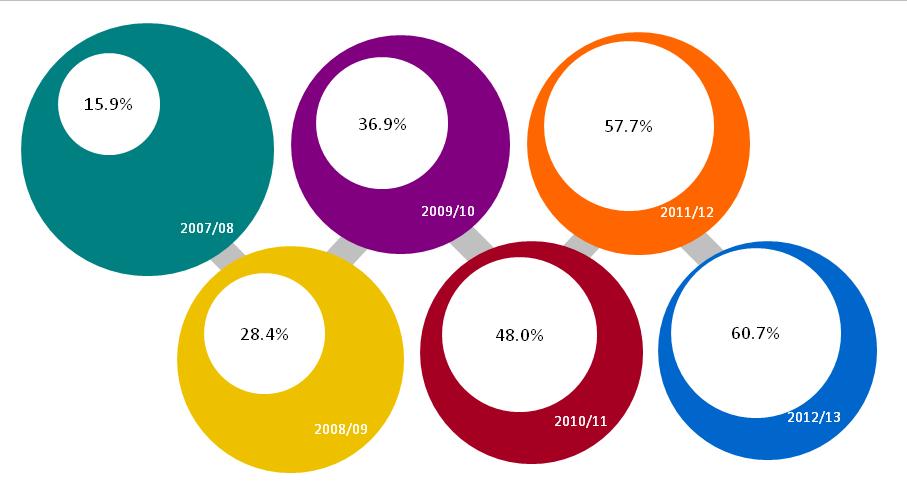
The image below illustrates the growth in online planning applications over the last few years. As you can see it has been remarkably steady.
We are now at what all business strategists would agree is the difficult 30%, the “late adopters”
It would be great to hear how you think we might tackle the businesses who have yet to join the party. Perhaps you could share your lightbulb moments, offer a testimonial or simply tell everyone when it was that your business flicked the digital switch.
Thanks to all the LPAs and presenters for braving the weather to attend our ‘Really Useful’ event on 13th February in Huddersfield.
Thanks also to Kirklees Council for providing excellent facilities and hosting the event free of charge.
With snow falling for the whole day, LPAs came from as far afield as Norwich for what was a useful and thought-provoking event.
Louise Tierney of Shropshire Council gave an insight into Project WIP – the council’s redesign of the planning services web pages and the key message of ‘designing for the customer and not the service area’. Read more…
Just spotted the launch of a series of events around the country where people are invited to go and have a chat and a cup of tea with local architects.
Launched by Gabrielle Omar, architect and former star of T.V’s The Apprentice. The sessions are described as a great opportunity to bring in ideas, designs and questions and benefit from a free consultation (and tea).
They are also looking for architects who might wish to offer their services.
Take a look at Tea with an Architect for more information.
Now where did I put those blueprints……..
Pie with a planner…..anyone!
I don’t know whether it’s my aftershave or our magnetic digital personality that attracts, but traffic to the Portal website continues to reach new heights.
In January there were almost 1.1 million visits to the site from more than 470,000 of you lovely people. That’s the same as filling Manchester City’s Etihad Stadium 10 times over and far more entertaining!!! (Forgive me I’m a Bradford City fan and these are high times.)
On a daily basis there are around 35,000 visits to the site and 300,000 page views.
All very gratifying.
Thanks
Birmingham City Council recently held its first electronic planning committee after ditching paper and using tablet computers.
Some of you may have read the city council started issuing tablet computers for its planning committee members as part of a pilot scheme in late November.
The six-month trial began at its 22nd November meeting, initially using the tablet devices in parallel with paper copies of agendas. Read more…
The Government has begun consulting on changes to current planning policy in relation to the strategic road network in general and roadside facilities like motorway service areas in particular.
One consequence of this initiative, signalled by roads minister Philip Hammond, would be the removal of the requirement for minimum distances between “signed roadside facilities”. Read more…
Communities Secretary Eric Pickles has announced he is ‘minded’ to approve developer Fox Strategic Land’s proposals for a 280-dwelling development at Sandbach in Cheshire, subject to a “satisfactory” agreement on affordable housing provision.
The Secretary of State had earlier refused consent for the scheme, the subject of a recovered appeal, in September 2011, in line with Cheshire East Council’s opposition to the project. Read more…
Two major onshore wind farms with a combined capacity of over 110 megawatts have obtained planning approval – one in England and the other in Wales.
The larger of the two schemes was Ecotricity’s 22-turbine project at Heckington Fen in Lincolnshire. The 66 MW wind farm was the subject of section 36 Electricity Act 1989 consent from energy secretary Ed Davey. Read more…


 Planning Portal Blog