
This increase is set by government to ensure local authorities can recover at least 90% of their costs when determining applications.
Changes are due to take affect from 8 December 2026, once the legislation has gained parliamentary approval.
Read more…
More than 800 planning professionals signed up for our latest SmartApply webinar, making it one of our most popular events to date.
We hosted the session for planning consultants, agents, architects and local authority colleagues to share our new features and the product roadmap ahead. The response was fantastic, and the live polls gave us a clear, first-hand picture of what matters most to the people who use SmartApply every day.
A huge well done to Scott Alford and Surabhi Deshpande, who both presented brilliantly. It was a real pleasure to share our vision, and the changes we’re making, with such a large and engaged audience.
What you want next: smarter readiness checks
Almost half of respondents (49%) said more sophisticated completeness and readiness checks would be the most valuable upcoming feature. A further 40% chose Site Check, which links site-specific information alongside the readiness check. Together, that’s nearly nine in ten attendees asking for the same thing – confidence that an application is right before it’s submitted.
| Upcoming feature | Share of votes |
| More sophisticated completeness & readiness checks | 49% |
| Site Check – site-specific information alongside readiness check | 40% |
| Project Workspaces – related applications, people and info together | 8% |
| Future application creation through Ask Navi | 3% |
217 responses.
When we asked which Planning Portal tools attendees had already used, supporting documents improvements (23%) and Building Control (16%) led the way, followed by CIL form integration (9%), the Constraints Checker (7%) and the Homeowner Insights Tool (7%). Only 1% had tried Ask Navi so far, so there’s plenty of opportunity to help professionals’ clients as more people discover the benefits of this tool. This particular function is also set to evolve quickly over the coming months, with new features being added regularly.
How SmartApply helps planning professionals
SmartApply is built around the day-to-day realities our audience described. Every improvement is designed to save time, cut rework and help applications move smoothly through to submission.
- Fewer invalid applications. Completeness and readiness checks (launching end of October) flag missing information before you submit, reducing the back-and-forth that delays validation.
- Faster route to validation. A complete, well-prepared application gives local planning authorities less to query, helping to tackle the turnaround times that nearly half of attendees named as their biggest challenge.
- Simpler supporting forms. CIL form integration brings Community Infrastructure Levy information into the application journey, rather than leaving it as a separate task.
- Easier document preparation. Supporting documents improvements help you prepare and format the files each application needs, with clear prompts to ensure nothing is nothing.
- Smoother project management. Recent enhancements have brought Planning and Building Control applications together in one view. It’s easier to collaborate and organise multiple projects, with increased visibility and flexibility to manage complex workstreams.
For agents, architects and consultants managing several applications at once, those savings add up. Less time on admin means more time for what matters: creating great places and communities.
Why this matters, and what’s next
SmartApply shapes applicants’ daily work, so this level of engagement was a powerful reminder of why our innovation matters. Every improvement we make saves professionals time and helps them focus on the work that counts.
The poll results will feed directly into our roadmap. Readiness checks and Site Check are clearly where you want us to go next, and we’ll keep sharing progress as those features take shape.
Thank you to everyone who joined, voted and asked questions, and thanks again to Scott and Surabhi for leading such a strong session.
Missed it? Catch it here.

Within Planning Portal, Projects gives users a place to bring related applications together. As the needs of professionals continue to evolve, so does Projects.
We’ve now expanded that capability so you can create and manage multiple projects, making it easier to organise work across a wider range of properties, developments and clients. Recent enhancements build on the Projects workflows, giving users greater flexibility to manage multiple projects, collaborate with others and keep track of applications as work progresses.
Read more…
From 1 October 2026, councils will need information to determine whether the new Building Safety Levy (BSL) applies to a development.
To help applicants provide the information local authorities need, Planning Portal has introduced a new ‘Building Safety Levy’ section to the ‘Full Plans’ online application type for building control.
This change will take effect from 1 October 2026.
Read more…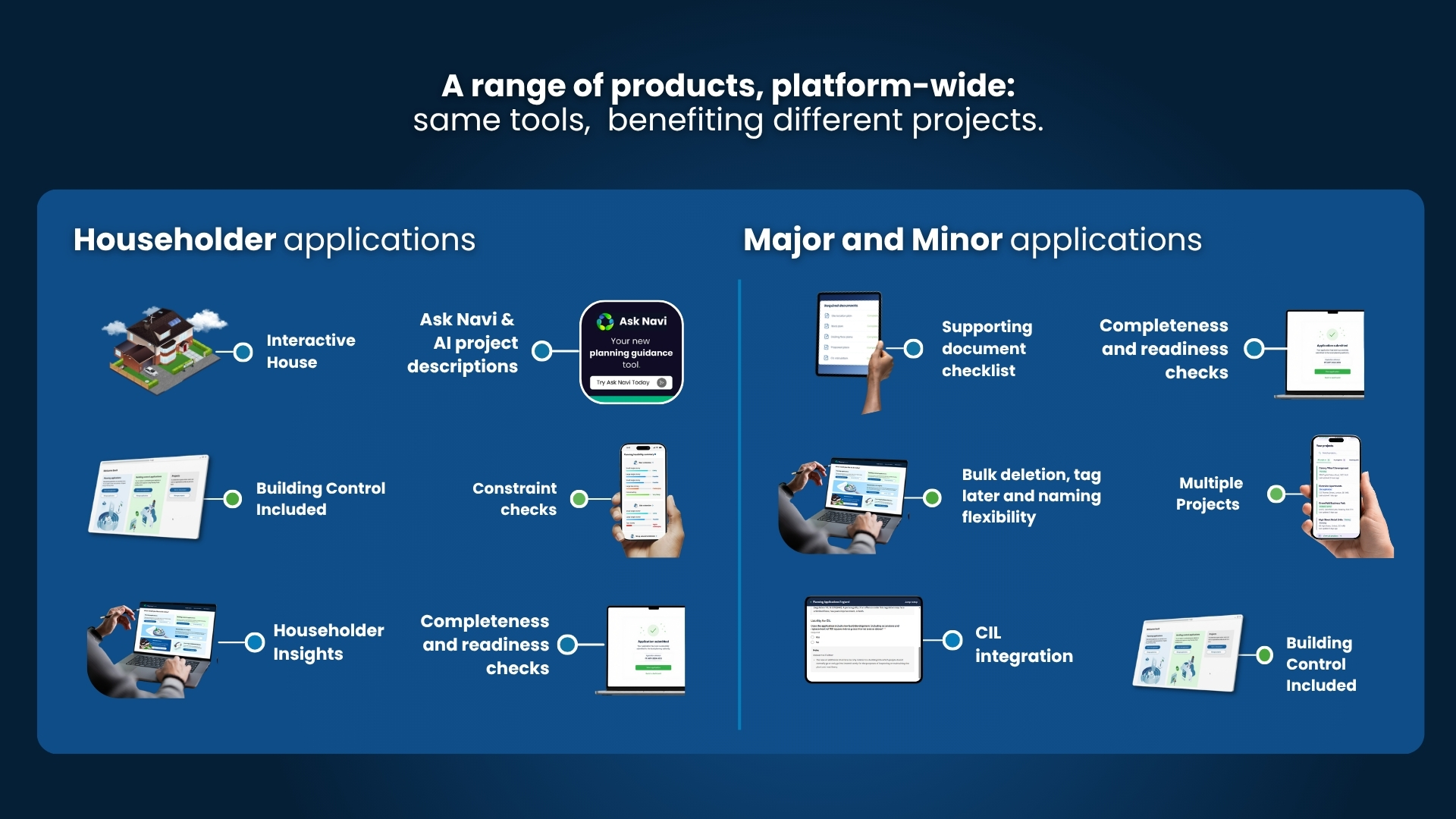
A closer look at how Band 2 supports different planning journeys; and the capabilities we’re continuing to build into Planning Portal.
Earlier this month, we introduced a new structure for Planning Portal alongside a significant expansion of the capabilities available across the planning journey.
Band 2 brings together application types that, based on our assessment, typically have more requirements and benefit from greater platform capability.
Read more…
From today, Planning Portal is bringing new data, intelligence, AI and smarter workflows into more of the planning journey. From understanding what may be possible, to preparing and checking an application, through to submission and Building Control.
Read more…
From today, Planning Portal is bringing new data, intelligence, AI and smarter workflows into more of the planning journey, with a clear aim for local authorities: help applicants understand more and submit stronger applications before it reaches you.
Read more…
Planning application activity remained broadly stable in July 2026, with 49,135 applications submitted during the month. This represents little change compared to June 2026, although application numbers were 5% lower than in July 2025.
Read more…
Changes intended to broaden the scope of solar installations for houses in England without requiring an application for planning permission were published by Government at the end of July, and come into force on 27th August 2026.
Read more…
The government has published the latest version of the National Planning Policy Framework (NPPF), introducing a series of changes aimed at creating a more streamlined, rules-based planning system and accelerating housing delivery.
The revised framework was published on 17 August alongside the government’s policy paper Creating a clear, rules-based planning system, which sets out plans to simplify and standardise the planning system, reduce duplication and clearly delineate plan-making and decision-making policies.
We break down some of the key updates below:
Read more…


