There has been an increase in the success rate for planning appeals since the introduction of the Government’s National Planning Policy Framework (NPPF) two years ago with a particularly significant improvement for residential appeals determined after public inquiries, according to new research published by Turley Associates.
Asset manager Henderson Global Investors’ application for consent for a £160m redevelopment of the former Smithfield Market in London’s EC1 has been rejected by Communities Secretary Eric Pickles.
Welsh Environment Minister dismissed
Welsh First Minister Carwyn Jones has fired his Environment Minister Alun Davies and will not appoint a successor.
Davies was dismissed for putting pressure on civil servants for private information about opposition Assembly Members.
While not directly relevant to Portal business, I thought anyone involved in neighbourhood planning might be interested in this rather clever interactive tool.
Developed using open data, it has been recently launched by the good folks over at Boilerhouse Media as part of their Making A Difference with Data project.
The map shows where neighbourhood plans are in the process of being developed or are in place.
It also signposts help and advice for anyone considering developing a neighbourhood plan in their area and has a useful feed using the Twitter hashtag #neighbourhoodplanning.

Image copyright: The Living
One of the most popular posts on this blog last year was the one about Bosco Verticale, two towers in Milan containing an amount of living trees equal to 10,000sqm of forest.
Continuing the theme of greener building is a project from architects The Living for the courtyard of Manhattan’s Museum of Modern Art, New York.
The ‘Hy-Fi’ structure is 100 per cent organic material. The embedded video explains how the structure uses bricks made from fungus and agricultural by-products that combine tremendous strength and flexibility while being 100 per cent compostable.
Each brick can be made in five days from a mixture of microscopic fungus and corn stalks and husks.
We warned you back in March that we were getting close to 80 per cent of all applications being submitted online, well with the release of the quarterly planning application statistics by DCLG last week we can see that we have made it!
Over the quarter Jan-Mar 2014, a whopping 81.6 per cent of all planning applications submitted across England and Wales have been made online via the Planning Portal.
With the average over the financial year 2013/14 standing at just shy of 77 per cent, we’re on track to meet the long-term objective of an average of 80 per cent over 2014/15.
Well done the whole Portal team who have worked so hard on this for so long and in particular our frontline staff on the support desk and account managers who work closely with our customers – whether applicants, agents or LPAs – on a daily basis.
And of course many thanks to you, our customers for your support, passion and on occasion, your patience! As you can see from the graph below, applications overall are continuing to rise at a rate of knots. 
A little while ago we blogged about the decision by DCLG to commercialise the Planning Portal.
Well today the procurement has kicked off and as a result, three of our team have stepped out of their day jobs to lead the Portal team’s bid to run the service ourselves.
DCLG will then consider our bid against the same criteria that they use to assess all bids submitted. Our director Chris Kendall is joined by account managers Scott Alford and Allen Camm for the foreseeable future – they’ll only return to the team once our bid is either out of the running or we are selected as the preferred bidder, so in the nicest possible way I hope they’re gone a long time.
You’re not so lucky though, as while Chris is gone you get my company on this blog. For those that don’t know me, I’m one of the Portal’s deputy directors, leading the folks that deliver the website content, work with LPAs and agents and sell our commercial services. Chris’ are difficult shoes to fill, but I’ll do my best.
If you’ve got any suggestions about what you’d like to see more or less of on this blog, please post a comment below or email me directly.
If you have any questions about the procurement process itself please direct them to DCLG.
The original version of this article appeared on the GOV.uk website
The Planning Portal is now open to investment from a commercial partner who can continue developing the service.
The Portal is highly valued as an important service which helps homeowners and businesses swiftly and efficiently navigate the planning system.
It occupies a unique market position. The Department for Communities and Local Government is now seeking a partner with innovative ideas that will take the service forward to make it easier to make planning applications that support sustainable development and economic growth.
Planning Minister Nick Boles said: “There is huge potential to take the Planning Portal to the next level and create services that will benefit businesses and homeowners.
“We have built a business that is well run and has a strong brand but now is the time for a firm to take it forward to fulfil its full potential. Bringing in external expertise is the best way to ensure the site works at its very best in the future.”
The Portal has more than a million visits each month, receives around 320,000 planning applications a year and allows planning applications to all local authorities in England and Wales to be submitted electronically through the website.
Customers that use the site include councils, architects, small businesses, shop-fitters, advertising companies, householders and housing and retail developers.
An information memorandum and bidding documents are now available on request setting out more details.
Email the commercialisation team at DCLG for more information.
In past months I’ve published a number of articles on how to pay for your planning application fee when submitting online.
With LPAs focussed on the channel shift of their planning services, many are reviewing processes to see how they can reduce validation errors. The most common invalidation reason for online applications is when payment is sent by cheque, even though it could be in the post and on its way.
In light of this many LPAs are encouraging payment at the time of submission, either online, by telephone or via the council website. This should help to create a win-win for LPAs and agents with a quicker and more efficient process for registration and validation.
This got us thinking about our online application service and how applicants can only find out the payment options local planning authorities (LPAs) support when you get you get to the final step of the submission process to ‘check, pay & submit’. So we’ve developed a simple tool that lets you search by LPA for the payment options they support so you can plan how and who is going to pay prior to submission.
We’ll publish this on the Portal shortly – we’re reviewing where to place this as part of the application process for quick reference.
In the meantime I thought I’d give you a sneak peek. You’ll need Excel installed on your PC for this to work. Please let us know what you think by adding a comment below.
Download the LPA payment tool (you’ll need to select the ‘Read Only’ option.)
Finally, a request to LPAs: please check the payment options you support.
It would be great if you could spend a couple of minutes checking the tool and that your payment options are correct, including the cheque payment address. With lots of office moves recently we don’t want cheques going astray.
Read instructions on how to update your details.
The daily submission of NMA applications has nearly doubled since we added the form to the suite of online applications in March.
There was high demand from both LPAs and agents to e-enable the form so I thought I’d give you an update on the stats.
LPAs were telling us that NMAs make up around five per cent of the total number of applications they were receiving so there’s quite a few that are still being submitted on paper.
The chart below gives you a daily break down of NMA applications submitted. 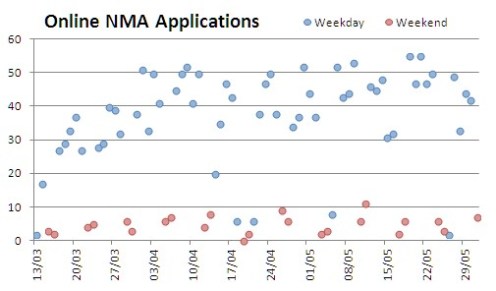 Please note: at the moment the NMA form is for LPAs in England only.
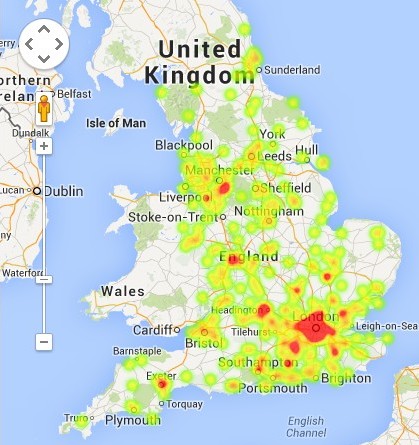
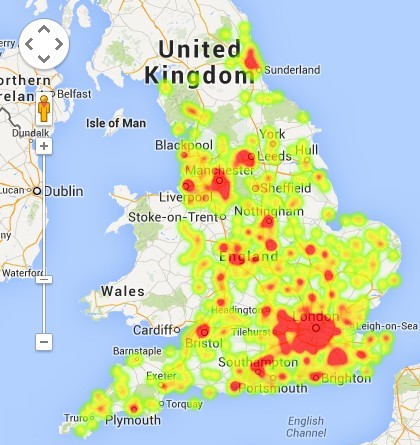
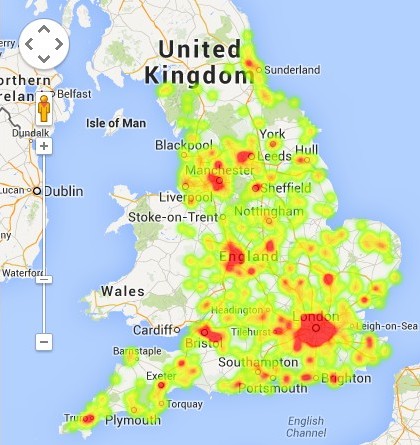
NMA Application Location Heat Maps
March
April
May
I thought it would also be useful to remind agents that discharge of condition applications can be submitted online using the Application for Approval of Details Reserved by Condition form.
Since 2011 we have seen online submission of them increase by 170%, and from the turn of this year we’re now getting over 2,700 submitted each month.


 Planning Portal Blog