A war of words has broken out in the wake of London Mayor Boris Johnson’s decision to block proposals for the £220m expansion of London City Airport which Newham Council wanted to see go-ahead.
A spokesperson for Johnson said: “The Mayor believes that granting planning permission for this scheme would lead to an unacceptable increase in noise for East Londoners and would not be for the greater benefit of the city.
“He has long argued that Heathrow Airport cannot be expanded due to the increased noise it would lead to in West London and he is not willing to expose East London to additional noise either.
“The Mayor continues to believe that a new hub airport to the east of London is the only long-term option that will provide enough aviation capacity – without detriment to the health and well-being of hundreds of thousands of people in London and the southeast – and allow the United Kingdom to compete with its global rivals.”
Mayor of Newham Sir Robin Wales was disappointed with the decision. He said: “Through a rigorous planning process, Newham Council had secured job opportunities for local people, money for vital local services and reduced environmental impacts on residents from the airport. “
London City Airport said it was “perplexed and disappointed” by the decision. It is expected to appeal.
Chief executive Declan Collier commented: “It is ironic that the Mayor of London, whose platform has always been one of advantage for business in London, is denying the capital the business opportunity presented by growth at London City Airport.”
Under the airport’s plans take-offs and landings were expected to increase from 70,000 a year to 111,000, with passenger numbers doubling to six million by 2023.
Read the Newham Council statement.
View the London City Airport press release
Communities Secretary Eric Pickles has confirmed important secondary legislation which introduces new permitted development rights from 15 April as well as newly consolidated Development Management Procedure Order. Pickles confirmed the Order in a written Commons statement (25 March).
This will simplify and streamline the planning application process for local planning authorities, applicants, and other users of the planning system.
The Order will also bring into force a number of important changes, including streamlining the process of statutory consultation and a new “deemed discharge” of conditions to ensure that planning conditions are cleared on time.
As well as changes in the Development Management Procedure Order, the administration has also introduced further measures to reduce and simplify the requirements to notify English Heritage and refer certain heritage applications to the Secretary of State.
“These will allow English Heritage’s resources and expertise to be focused where they can add most value, while still maintaining an effective level of protection for the historic environment,” insisted Pickles.
The permitted development rights include allowing more change of use between shops and financial and professional services, allowing the change of such uses to restaurants or leisure use, and allowing retailers to adapt their facilities more freely to support click and collect
The new measures will also allow change of use from some business uses to residential and continue to allow larger, rear domestic extensions (the Government has also clarified the wording on front extensions following requests by some local authorities).
The new provisions will allow commercial filming for longer periods, larger capacity solar panels on non-domestic buildings, make permanent larger business extensions and allow like-for-like replacements within waste management facilities and allowing equipment housings for sewerage undertakers.
The administration is also introducing a new requirement to enable local consideration of a planning application for any change of use to a betting shop or pay day loan shop
Pickles added: “The Government will further consider the case for extending the office to residential reforms, which are helping provided more new homes on brownfield land.”
Read the written statement to Parliament
The Town and Country Planning (Development Management Procedure) (England) Order 2015
The Town and Country Planning (General Permitted Development) (England) Order 2015
Communities Secretary Eric Pickles has supported Salford City Council and blocked controversial outline plans to build 600 homes and a canal-side marina on open land at Broadoak between Monton and Worsley in Salford.
Developers Peel Group and Taylor Wimpey UK wanted to build the residential-led mixed-use scheme at a greenfield location, a mixture of woods, meadows and open land safeguarded by so-called Greenway policies in the City’s Unitary Development Plan.
There were also proposals for a new marina on the Bridgewater Canal, shops and cafes, new green space provision and new footpaths and the creation of an ecological mitigation area
The inspector who held the recovered appeal recommended against the scheme. Pickles’ decision letter made it clear the Secretary of State shared the inspector’s concern that “the appeal proposal’s complete obliteration of a section of the Greenway and its consequent fragmentation and loss of continuity is a high price to pay for making a very small contribution towards meeting the [acknowledged] housing shortfall”.
Pickles also agreed that it the scheme went ahead “there would be fundamental harm to the Greenway’s openness and to its value as an amenity, recreation and wildlife corridor”.
The Secretary of State concluded that the proposals breached both local and national planning policies.
“The adverse impacts of this proposal would significantly and demonstrably outweigh the benefits when assessed against the policies in the National Planning Policy Framework taken as a whole”.
Pickles also stressed there were no considerations of sufficient weight to indicate the scheme should be “determined other than in accordance with the development plan”.
Read the full decision letter and inspectors report.
Green light for Manchester rail project
Transport Secretary Patrick McLoughlin has approved a Transport and Works Act Order for a new rail viaduct in Manchester linking the Bolton Lines railway near the Castlefield Centre with the Chat Moss Lines railway near Salford Central station in the Ordsall area of Greater Manchester.
The order authorises the compulsory purchase of land for the scheme – known as the Ordsall Chord – which will provide a direct link between the city’s three main stations: Victoria, Oxford Road and Piccadilly.
The £85m is a key element of the multi-million pound Northern Hub upgrade for rail services across the North of England.
Network Rail said it would ease a “rail bottleneck” south of Piccadilly and enable more trains to travel through Manchester city centre.
Controversially, the scheme involves the demolition or harm to the settings of a number of heritage assets including Grade 11 listed bridge and viaducts and three Grade 1 listed buildings. The scheme will cause substantial harm to the character and appearance of the Castlefield conservation area and result in the loss of a number of unlisted homes.
Read the Ordsall Chord decision letter
Read the Ordsall Chord inspectors report
View more details of the Northern Hub
Crackdown on unauthorised encampments
Ministers have written to English local councils and police authorities voicing concern over reports they are not being seen to be doing enough to stop unauthorised traveler encampments.
The letter, from the Department for Communities and Local Government, the Home Office and the Ministry for Justice, stressed that local authorities and the police had sufficient powers to take action including the use of temporary stop notices.
The letter said: “Public bodies should not gold-plate human rights and equalities legislation. Councils and the police have been given strong powers to deal with unauthorised encampments”.
Whitehall has published a guide setting out a summary of available powers.
Read ‘Dealing with illegal and unauthorised encampments: a summary of available powers’
Grant waiver unlocks Nantwich site
Plans to develop new homes and leisure facilities on a former gas works site in Nantwich, Cheshire can now go ahead following a Government decision to waive repayment of a £409,000 derelict land grant.
The St Anne’s Lane gasworks site has been empty for a quarter of a century and has been used by the town as a free car park.
Housing and Planning Minister Brandon Lewis has confirmed that he is waiving repayment of the grant to enable Cheshire East Council to put forward a scheme creating new homes, leisure facilities and jobs.
The site was the town gasworks from around 1877 until the 1970s.
NSIP regime changes
A commencement order has been laid in Parliament to implement changes to the Planning Act 2008 which were included the Infrastructure Act 2015. These will allow for the early appointment of inspectors and modify the post-consent change process.
Meanwhile, last week MPs voted to add projects for the long-term geological disposal of radioactive waste to the Planning Act 2008 regime, by 277 votes to 33.
In addition, the government has revised its guidance on the pre-application and examination stages of Nationally Significant Infrastructure Projects (NSIPs).
The Infrastructure Act 2015 (Commencement No. 2 and Transitional Provisions) Regulations 2015
Read the NSIP pre-app guidance
Read the NSIP examination guidance
Funding help for major Leicestershire housing scheme
The Department for Communities and Local Government has announced a multi-million pound deal to ensure a 4,000-home development in Leicestershire gets underway.
This involves the New Lubbesthorpe development near Leicester designed to provide 4,200 homes as well as shops, schools and a health centre.
Developers ERB Drummond Trust will receive a loan for key infrastructure linking Lubbesthorpe and Leicester city centre including a new road bridge across the M1 motorway as well as well as funding towards other improvements, including a primary school and a new park.
Loan deal to boost London dockland development
A major new development at the heart of London’s Docklands should begin to climb off the drawing board in a matter of months thanks to a £200m Government loan to Canary Wharf Group.
This will allow for key infrastructure work to go ahead in preparation for the next phase of the Canary Wharf (formerly called Wood Wharf) development. Some 3,500 homes as well as offices, shops and leisure facilities are involved.
New highways body sets out stall
Highways England, the Government-owned company which will deliver the largest investment in England’s major roads in a generation, officially launched this week on 1 April.
The company is scheduled to invest £11bn in delivering a raft of improvements to England’s motorways and major A roads designed to improve traffic flow and reduce congestion.
According to its first delivery plan, just published, the new entity will take a comprehensive approach on environmental issues by investing £225m on flood resilience schemes, encouraging biodiversity around roads and protecting and restoring nature areas as well as tackling noise pollution using low-noise surfacing at 1,150 locations.
Read the Highways England press release
Read the ‘Highways England Delivery Plan 2015-2020’
English coastal path move
Natural England has published formal proposals to improve public access along the English coast between Filey Brigg in North Yorkshire and Newport Bridge in Middlesbrough.
If approved, this route will become part of the England Coast Path along a 111km stretch of the North Yorkshire and Teesside coastline, taking in the North York Moors National Park and parts of the Cleveland Way National Trail.
This is the first time proposals have been published for the route in Yorkshire and the longest section of coast path to be developed so far.
The first north-east section of the England Coast Path was opened last April, running along 55km of coastline between North Gare in Hartlepool and South Bents in Sunderland.
View the consultation on GOV.uk
Northern Ireland reclaims local planning
Northern Ireland’s 11 new-look local authorities assumed major new planning powers and responsibilities this week beginning on 1 April after decades of a largely Government-run regime.
View further details of Northern Ireland’s local government reform
Green belt report
Latest research shows that more houses are planned for green belt land in England than when the Coalition’s flagship planning reform – the National Planning Policy Framework (NPPF) – was implemented three years ago, the Campaign to Protect Rural England (CPRE) has claimed.
The CPRE said that 219,000 houses are planned for England’s green belt, 60,000 more than in August 2013 when CPRE last made a count.
CPRE’s analysis of nine English regions highlighted that three city or county regions – London, Oxfordshire and Nottinghamshire – as well as the wider South West region – are all facing an increasingly large number of houses on green belt land.
It also noted that planning inspectors have signed off major releases of green belt in areas such as Leeds and Newcastle/Gateshead where there is ample brownfield land available.
Paul Miner, planning campaign manager at CPRE, said: “Ministers have quite rightly resisted the siren calls of some organisations to relax controls over development in the green belt.
“Yet, our new research shows that large-scale development is already planned – despite existing protections, the availability of brownfield land and community objections.”
Read the report ‘Green Belt under siege: the NPPF three years on’
DCLG subsumes architecture from DCMS
The Design Council has welcomed the transfer of architecture policy function from the Department for Culture, Media and Sport to the Department for Communities and Local Government will now be responsible for promoting high-quality design in the built environment.
Clare Devine, director of architecture and the Built Environment at Design Council, said: “This is a practical step which we wholeheartedly welcome.
“Given that the department already looks after the means to deliver good quality places – the planning system, local government finance and the Community Rights programmes – it is a positive move to bring these together.”
Read the design council press release
Report urges urban villages
Think-tank IPPR has published a collection of essays arguing the case for a slew of new so-called ‘city villages’ to help meet the current housing shortage.
The publication said this will need creative, concerted action by the public, private and not-for-profit sectors, and by national and local government.
The think-tank described ‘city villages’ as areas of redevelopment and regeneration within the cities, including significantly more and better housing at a broad range of price and rent levels.
These would be facilitated by local authorities leveraging their land ownership, particularly their ownership of existing council estates, in partnership with private and voluntary sector developers.
According to the IPPR ‘city villages’ would comprise socially mixed, multi-tenure housing, planned not just as housing developments but as entire communities with integral and modern commercial, retail and transport facilities.
View the IPPR press release and access the essays
Bristol entertainment development boost
Bristol’s proposed £91m entertainment arena has taken another step forward after the land for the site was formally handed over to the city council.
The agreement will also see £5.4m of government funding to the city to help develop other sites within the Temple Quarter Enterprise Zone. Last month, Populous was chosen to build the 12,000-seat venue which is due to open in 2017.
Read the Homes and Communities Agency press release
Three more neighbourhood plans pass the referendum test
The first ever neighbourhood plan in the North East has been approved after a referendum. Some 78 per cent of residents of the Northumberland parish of Allendale who voted supported the land use strategy.
Meanwhile, two other neighbourhood plans successfully passed the referendum stage last week. In East Devon over 86 per cent of the residents who went to the polls endorsed the Lympstone Neighbourhood Plan. In Mid Sussex nearly 74 per cent of those who voted in the referendum over the West Hoathly Neighbourhood Plan backed the new-look development plan.
Download the ‘Allendale Neighbourhood Development Plan’ (PDF)
View further details of the Lympstone Neighbourhood Plan
View further details of the West Hoathly Neighbourhood Plan
Chief executive named for Ebbsfleet UDC
The Government has confirmed that the proposed Ebbsfleet Urban Development Corporation will be operational in April and have planning powers in July.
Robin Cooper, currently deputy chief executive of Medway Council, has been named as the UDC’s chief Executive and ex-officio board member.
Councillor Paul Carter CBE (leader of Kent County Council), councillor Jeremy Kite MBE (leader of Dartford Borough Council) and, subject to ratification, councillor John Burden (leader of Gravesham Borough Council) will be appointed to serve on the corporation’s board.
View further details on GOV.uk
Lights, camera, action…
The Planning Inspectorate has published a short film that highlights the key role planning inspectors play in supporting local councils develop local plans that meet their needs and those of the communities they serve.
Legal round-up
- Spencer Flower, a former leader of Dorset County Council, has become the first person to be successfully prosecuted for voting about the fate of a core strategy contrary to the provisions of the Localism Act 2011. He had claimed that his involvement with a social housing company was not relevant to a debate in 2013 about East Dorset District Council’s Core Strategy.
- The developer of a proposed crematorium outside Aylesbury in Buckinghamshire has succeeded in persuading a High Court judge to quash planning approval for a rival scheme because Aylesbury Vale District Council failed to take into account the risks posed to colonies of protected great crested newts.
- A developer who wanted to build 250 homes on a former airfield in Kent has failed in a High Court challenge over the refusal of planning permission and the arguments used by the planning inspector who dismissed the appeal.
The Old Oak and Park Royal Development Corporation (OPDC) will come into force on 1 April.
OPDC has been championed by the Mayor of London as the body that will drive the regeneration of 900 hectares of industrial land in west London.
On 1 April OPDC will take on planning powers for the area including the power to determine planning applications, prepare planning policy and prepare and collect CIL. In addition, OPDC will have the ability to use Compulsory Purchase Order powers to secure regeneration.
Old Oak and Park Royal DC sits across the boundaries of three London Boroughs – Brent, Ealing and Hammersmith and Fulham, and will be established as a new local planning authority (LPA) on the Planning Portal to facilitate its introduction.
This means that with effect from 1 April 2015, any applications created on the Planning Portal within the new DC boundary will be submitted to the new authority.
More information about OPDC is available on the GLA website.
DCLG confirms raft of planning reforms
The Department for Communities and Local Government (DCLG) has published its responses to recent consultations on the use of planning conditions, the consent process for nationally significant infrastructure projects (NSIPs) and changes to statutory consultee arrangements.
Transitional planning regime for Ebbsfleet Garden City announced
Planning minister Brandon Lewis has announced transitional arrangements for planning as the urban development corporation which will be responsible for creating the new 15,000-home garden city at Ebbsfleet in Kent is set up.
Gloucester master plan unveiled
A £135m master plan to regenerate nearly three hectares of land across the Quayside and Blackfriars sites in the centre of Gloucester has been presented to potential investors.
Latest alteration to London Plan approved
The revised city-wide planning strategy to deliver the economic, environmental, transport and social improvements that London will need over the next 20 years has been published by the capital’s Mayor Boris Johnson.
Panel cold-shoulders single designation route for key Welsh landscapes
The independent panel set up to advise the Welsh Government on designated landscapes – National Parks and Areas of Outstanding Natural Beauty (AONBs) – has come down firmly against a single designation.
News round-up 12 March 2015
An overview of the other planning stories of this week…
We’re pleased to say that the ownership of the Planning Portal has this week been transferred to a private sector, joint venture between DCLG and TerraQuest.
At long last this will give us the opportunity to invest in and improve the core product. The existing service and content will be retained and built on when a refreshed service goes live later in the year.
All of the team have transferred over to the new company and will continue to provide the same levels of service you’ve come to expect.
We’re champing at the bit to get on with the next phase in our evolution and to build an even better service at the heart of this critical industry. We look forward to working with you on that and to your continuing feedback and support.
Starter home planning policy initiative confirmed
The Government this week kick-started its ambitious scheme to generate starter homes, which will be offered to young, first-time buyers at a 20 per cent discount, paid for by exempting developers from infrastructure payments.
Latest English household formation projections published
The Department for Communities and Local Government has published its latest official projections of household formations, estimating the formation of 5.2 million new households in England between 2012 and 2037.
Pickles blocks Gladman housing schemes in Buckinghamshire and Cheshire
Communities Secretary Eric Pickles has dismissed two separate appeals by Gladman Developments involving proposals for sites in Buckinghamshire and Cheshire.
Devolution package proposes greater planning powers for Wales
The Coalition has confirmed moves to give the Welsh administration greater planning powers in line with the recommendations of the Silk Commission.
News round-up 5 March 2015
An overview of the other planning stories of this week…
Update: 16:20. The Portal site is now back up.
We are currently experiencing a technical issue with the Planning Portal, which means the site has been unavailable since late morning.
First and foremost: please accept my apologies for the inconvenience this is causing you.
We are working hard with our technical partner to resolve this issue.
In February we received 40,624 online applications, which equates to 38,177 total submissions – a huge 19.3% increase on the same period 12 months ago.
In line, the work-day averages for submissions have also increased. February was a record month with 1,863 applications submitted each working day. So far March is even higher with daily submissions hovering around the 2,000 mark. The work-day average for online applications in March has roughly doubled from 2012
This chart shows the change in daily submission over the last few years.
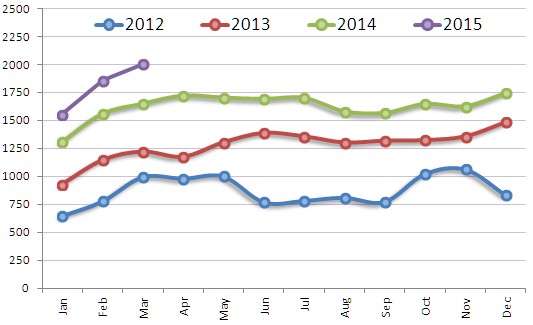
Does this indicate an increase in total planning applications or just those submitted online?
We won’t know for sure until DCLG publishes its PS1/2 returns reports sometime later this month but we suspect it’s a bit of both.


 Planning Portal Blog