The application numbers for March are now in. It looks you’ve been busy again as it was a bumper month for applications – up 22% on last March at 46,739!
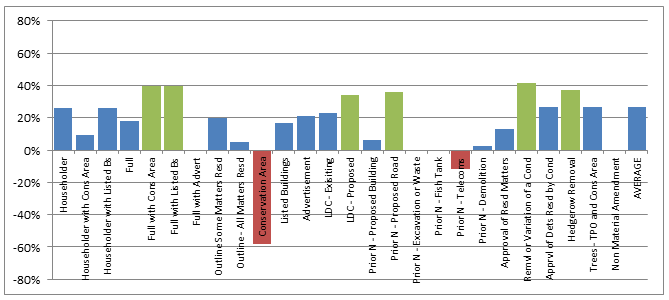
That brings the total for the financial year 2014/15 to a whopping 458,276 applications. Below you can see the increases (and in some cases decreases) of all the application types that can currently be submit through the Planning Portal from 2013/14 to 2014/15 as a whole.
Some types of application (shown in green) outperformed the average yearly increase, in particular “Full With Conservation Area”, “Full with Listed Buildings” and “Removal or Variation of a Condition” at around a 40% increase. The falls we saw were either down to policy changes (affecting Conservation Area) or change in business practices (some Prior Notifications).
You can click the image below to expand it.
Local plan progress over the last three years since the National Planning Policy Framework (NPPF) was published has been “marginal”, according to an assessment by Nathaniel Lichfield & Partners.
The consultancy pointed out that only a quarter of English local authorities have a NPPF-compliant up-to-date adopted plan.
Around a fifth have a plan submitted and an examination underway or forthcoming. Some 62 plans have been found sound. But 21 have been withdrawn because of concerns over soundness while 32 per cent of adopted plans require an immediate or early review.
The report: ‘Signal Failure: A Review Of Local Plans And Housing Requirement’ highlighted that the Planning Policy Guidance launched in March 2014 was not being applied consistently.
The authors of the report stressed that “plans are not yet dealing effectively with ‘overspill’ issues, particularly from urban areas.
“This is the next major hurdle for plan-makers: even where the scale of unmet need is known (as with London and Birmingham), there is limited evidence of plans or inspectors answering vital questions over how the overspill is distributed to surrounding locations.”
On average it now takes five months longer for plans to be found sound after being submitted than it did before the NPPF was introduced.
Particular problems noted by the research included identifying which neighbouring authorities will be asked to meet the housing overspill that cannot be accommodated by the council itself.
Also looming large was the fact that authorities constrained by large green belts appeared to be dragging their feet over housing requirements in their plans.
Read the report on the Nathaniel Lichfield & Partners website.
Roger Milne
Communities Secretary Eric Pickles has intervened directly over the level of housing that North Somerset District Council is being expected to provide in its core strategy.
The Secretary of State has taken the unprecedented step of announcing he will look at the housing provision required by the planning inspector who handled the core strategy examination.
The Secretary of State noted that the strategy has “undergone a complex and protracted examination at a time of transition in national planning policy”.
He added: “I wish to review and consider the inspector’s conclusions on Policy CS13 Housing Requirement to ensure national policy has been applied and reflected correctly. I wish to ensure that there is maximum clarity for the community on the outcome of the examination.”
North Somerset originally adopted the strategy in April 2012 with a housing policy to plan for 14,000 houses. Following a legal challenge, the policy was found to be unlawful on the grounds that the independent planning inspector had failed to give adequate and intelligible reasons for his support of the council’s housing requirement.
The plan was then referred back to PINS and, despite the council agreeing in the meantime to increase the number to 17,000, a further examination resulted in a new inspector concluding that 17,000 houses was still insufficient to meet the council’s needs.
Instead, the inspector confirmed a housing figure of 20,985 – a 50 per cent increase on the council’s original number. Two local MPs and the planning authority wrote to the Secretary of State asking him to review the housing figure
David Turner, director of development and environment for the council, said: “We have been working hard with the Planning Inspectorate to reach a deliverable approach to balancing future housing needs while respecting the considerable environmental constraints, including green belt, that define our area.
“It is gratifying that the Secretary of State acknowledges the unique set of circumstances that have prevented us from having an adopted plan, and that he considers it necessary to review the inspector’s conclusions.”
In the meantime the council will use the evidence it has prepared through the examination process to decide planning applications for new housing development and will continue to resist inappropriate development proposals that would damage the environment of North Somerset.
Roger Milne
Communities Secretary Eric Pickles has dismissed an appeal over proposals for a residential scheme involving 146 homes on farmland at Stow-on-the-Wold in the Cotswold Area of Outstanding Natural Beauty (AONB).
Developer Bovis Homes had applied to Cotswold District Council for outline planning permission for the scheme earmarked for farmland on the eastern flank of the town.
It lodged an appeal after the planning authority failed to determine the project within the prescribed period. The planning inspector who held the recovered appeal recommended the scheme should be blocked.
The Secretary of State agreed that the appeal scheme constituted major development within an AONB where, according to the National Planning Policy Framework (NPPF) “planning permission should be refused for major development except in exceptional circumstances and where it can be demonstrated that it is in the public interest”.
He also acknowledged that the scheme would make a significant contribution to housing land supply in a district where the level of supply fell significantly short of the five-year requirement set out in the NPPF.
In addition the Secretary of State agreed that it seemed likely that some development would have to take place within the AONB at Stow if future housing needs are to be met and that some of this growth will be on greenfield land at the periphery of the settlement.
But Pickles’ decision letter made it clear that the Secretary of State attached “great weight to the harm which the scheme would cause to the AONB”.
He considered that the appeal site was “highly sensitive” and there was scope for meeting Stow’s housing requirements through smaller-scale alternatives with the potential to cause “less harm to the character and appearance of the AONB and the setting of Stow”.
Overall, the Secretary of State concluded that “the benefits of the proposal would be far outweighed by the environmental harm that it would cause”.
He insisted the exceptional circumstances required to justify the development did not exist. Allowing the scheme would not be in the public interest, Pickles said.
Roger Milne
House builders and councils should strive for the highest design quality when planning new starter homes, housing and planning minister Brandon Lewis has insisted.
His comments came as the administration’s recently established Design Advisory Panel published details of so-called exemplar schemes which include terraced housing built at Prince Charles’ Poundbury development near Dorchester, Dorset.
The Government has launched a starter homes initiative for young first-time buyers. The expectation is that thousands of new homes will be made available with a 20 per cent discount on the market price. This will be achieved by building on brownfield sites and exempting house builders from Community Infrastructure Levy (CIL) and any requirement to provide affordable housing.
The panel which includes leading architects like Sir Terry Farrell and Quinlan Terry CBE has highlighted examples of existing schemes that demonstrate high-quality designs.
Lewis said the Pane’s guided offered “a clear vision of the high standards that new homes across the country are meeting, with examples that developers will be able to take inspiration from”.
The examples cited involved housing schemes across the country which are already, or close to, being completed. The size and type of the homes include terraced and semi-detached houses and flats. The projects include a range of densities and building heights. And there are distinct design approaches, architectural styles and types of building materials.
As well as the Poundbury scheme the exemplars involve homes at Bude, Cornwall; Bicester, Oxfordshire; Letchworth in Hertfordshire; Northampton; north London and York.
Roger Milne
New housing standard requirements for new dwellings have come into force as part of the Government’s drive to simplify and streamline the regulations facing house builders.
Following the administration’s Housing Standards Review, the only technical standards that will continue to be applied through planning permissions locally will be on the five key themes – energy, water, access, space and security. All other standards will no longer be able to be imposed.
For instance, a broad requirement to meet a particular ‘Code for Sustainable Homes’ level will no longer apply.
A plan policy which specifically requires building to lifetime homes standards, which is under the ‘access’ theme, would continue to apply but delivery of a home to this standard as an indirect effect of achieving points for a Code for Sustainable Homes level, would no longer apply.
The Department for Communities and Local Government has said that for the first six months (i.e. up to 1 October when new Building Standards kick-in) for water, space, security and access the ‘old’ existing standards could continue to be applied based on existing plans, rather than the optional new requirement or national space standard.
From 2016 all homes will be zero carbon, through a mixture of raised building standards and ‘allowable solutions’ such as offsite energy sources and contributions to clean energy schemes.
However, sites of fewer than 10 homes will be exempt from the allowable solutions requirements, with safeguards against abuses; and an impact assessment on allowable solutions.
Roger Milne
Key new legislation comes into force
As a result of two new Bills which received Royal Assent last week the Ebbsfleet Development Corporation has come into formal existence, short-term lets in the capital will no longer require planning permission and councils will be required to establish local registers of people looking to buy plots of land to commission or build their own home.
Those measures resulted from the Deregulation Act and the Government-supported Self-Build and Custom Housebuilding Act. Planning powers for the Ebbsfleet Development Corporation will come into force in July.
Councils must now take account of the demand for self and custom build when exercising their planning housing, regeneration and land disposal functions.
Go-ahead for Boston development
Proposals for a £100m mixed-use scheme which will provide a new football stadium, 500 homes as well as retail facilities and a hotel in the Lincolnshire market town of Boston have been given the go-ahead.
A s106 agreement has been signed between Boston Borough Council and developer Chestnut Homes and Boston United Football Club for the Quadrant project earmarked for land on either side of the A16 at Wyberton.
The scheme involves a 4,000-seater ground for the Conference North club and new homes, 100 of which will be affordable.
Expenditure on infrastructure to open up land for a strategic business park and housing development in the Dearne Valley close to junction 36 of the M1 has been approved by members of the Sheffield City Region Combined Authority.
Leeds traveller pitches dismissed
Communities Secretary Eric Pickles has called-in and refused Yorkshire Housing Ltd’s proposal for a 12-pitch traveller and gypsy development earmarked for a green belt location at Gilderstone near Morley, Leeds. The inspector who considered the scheme had recommended refusal.
Pickles, like the inspector, acknowledged there was an immediate, urgent and substantial need for additional pitches but concluded this was not sufficient to outweigh the disadvantages of the harm to the green belt.
Central Bedfordshire developments
Central Bedford Council has approved a development strategy for land north of Luton and the proposed Sundon sub-regional rail freight interchange
The area will provide a mix of up to 4,000 homes (including up to 30 per cent affordable housing), office and retail floor space, new schools, accessible open space, and sports and leisure facilities as well as a major new east-west route from the new Junction 11A of the M1 to the A6.
In a related move the local planning authority has approved the Wixams Park master plan which will guide development on land south of the separate main Wixams settlement which is being developed by Gallagher Estates.
The plan sets out proposals for around 1,500 new homes and 5 hectares of employment land, accessible both from the development and the new highway network from the B530
Aardman opposition to Bristol site
An open letter opposing a redevelopment of a derelict Bristol site has been signed by the boss of Wallace and Gromit creator Aardman Animations.
David Sproxton is part of a group claiming that the proposals for the site which includes a Grade 11 listed building and the neighbouring Westmoreland House would result in a “gated community”.
Lincolnshire turbines blocked
Plans for a nine-turbine wind farm on land north west of Skegness and near Orby village in Lincolnshire have been refused on appeal by Communities Secretary Eric Pickles.
Pickles agreed with the inspector who held the recovered appeal that the benefits of the scheme did not outweigh its disadvantages. These included unacceptable harm to the living conditions of nearby residents and adverse impacts on the landscape and the setting of heritage assets in the vicinity of the planned project which had been rejected by East Lindsey District Council.
Croydon affordable homes boost
Croydon Council in south London has introduced new requirements for all developments built outside the town centre to provide a minimum of 50 per cent of the new homes as affordable housing. The new requirement kicked-in on 1 April.
The minimum level was 30 per cent but the local plan policy allows this to be reviewed each year in response to market changes. The policy will apply to all future planning applications until the next review in April 2016.
Nottingham shopping centre makeover
Ambitious proposals for the redevelopment of the Broadmarsh shopping centre in Nottingham have been lodged with the city council by owner Intu.
A new multi-screen cinema, restaurants and an improved walkway from the train station to the city centre are key elements of the £150m package.
Roger Milne
Appeal decisions should recognise what planning minister Brandon Lewis has called “the intrinsic character and beauty of the countryside”. They should also ensure that “development is suitable for the local context”.
That was stressed by the minister in a letter sent to Simon Ridley, chief executive of the Planning Inspectorate, in which Lewis voiced concern over how landscape issues are being handled.
Lewis said: “I have become aware of several recent appeal cases in which harm to landscape character has been an important consideration in the appeal being dismissed.”
He added: “These cases are a reminder of one of the 12 core principles at paragraph 17 of the National Planning Policy Framework – that plans and decisions should take into account the different roles and character of different areas, and recognise the intrinsic character and beauty of the countryside – to ensure that development is suitable for the local context.”
The minister acknowledged that although National Parks, the Broads, Areas of Outstanding Natural Beauty and Heritage Coasts quite rightly enjoy the highest degree of protection, “outside of these designated areas the impact of development on the landscape can be an important material consideration”.
Lewis said: “We are publicising some of these appeal cases more widely, with the help of the Planning Advisory Service, to promote greater understanding of how landscape character can be taken into account by local planning authorities in their decisions
“These cases also reflect the wider emphasis on delivering sustainable outcomes at the heart of the Framework, which means taking full account of the environmental as well as the economic and social dimensions of development proposals.”
The minister also used the letter to restate the Coalition’s stance on prematurity, and the particular factors that need to be considered when doing so.
He added: “The weight that can be attached to an emerging plan will need to be considered carefully when assessing whether a prematurity argument is justified. We will continue to consider whether this careful balance is best serving local communities.”
The saga of farmer and landowner Robert Fidler’s unauthorised house built in the green belt near Redhill, Surrey about 15 years ago has reached the endgame.
For the first four years of its existence the building with its faux Tudor façade and castellated towers was hidden behind straw bales.
Subsequently, the property has generated a number of applications, appeals and litigation. In what seems to be his last throw of the dice, Fidler had applied to retain the building as an agricultural worker’s dwelling, a move refused by Reigate & Banstead Borough Council.
Communities Secretary Eric Pickles has determined similarly even though the inspector who held the recovered appeal recommended that the appeal should be allowed and permission granted for a maximum period of three years.
Pickles disagreed, insisting there were “no very special circumstances justifying the harm to the green belt and any other harm caused by the dwelling which would justify granting planning permission in this case whether permanently or on a temporary basis”.
A suspended High Court injunction order now takes effect, with the result that Mr Fidler now has 90 days from the Secretary of State’s decision within which to demolish the dwelling, explained barrister Stephen Whale of Landmark Chambers, which successfully represented the planning authority at the injunction proceedings.
Read the full decision letter and inspectors report.
A war of words has broken out in the wake of London Mayor Boris Johnson’s decision to block proposals for the £220m expansion of London City Airport which Newham Council wanted to see go-ahead.
A spokesperson for Johnson said: “The Mayor believes that granting planning permission for this scheme would lead to an unacceptable increase in noise for East Londoners and would not be for the greater benefit of the city.
“He has long argued that Heathrow Airport cannot be expanded due to the increased noise it would lead to in West London and he is not willing to expose East London to additional noise either.
“The Mayor continues to believe that a new hub airport to the east of London is the only long-term option that will provide enough aviation capacity – without detriment to the health and well-being of hundreds of thousands of people in London and the southeast – and allow the United Kingdom to compete with its global rivals.”
Mayor of Newham Sir Robin Wales was disappointed with the decision. He said: “Through a rigorous planning process, Newham Council had secured job opportunities for local people, money for vital local services and reduced environmental impacts on residents from the airport. “
London City Airport said it was “perplexed and disappointed” by the decision. It is expected to appeal.
Chief executive Declan Collier commented: “It is ironic that the Mayor of London, whose platform has always been one of advantage for business in London, is denying the capital the business opportunity presented by growth at London City Airport.”
Under the airport’s plans take-offs and landings were expected to increase from 70,000 a year to 111,000, with passenger numbers doubling to six million by 2023.
Read the Newham Council statement.
View the London City Airport press release


 Planning Portal Blog