Application system update: Ensuring eligibility for the most used Biodiversity Net Gain exemptions
As a part of monitoring the implementation of biodiversity net gain (BNG), we have been studying the data from submitted applications and engaging with the sector to determine how we best ensure applicants correctly identify when the BNG condition will or will not apply to their proposed developments.
Where applicants state BNG will not apply, we already ask them to select the reason(s) why it will not apply as well as entering the justification(s), but from 17th October 2024 we will be improving this journey to further help applicants assess the eligibility of their applications.
Changes when selecting certain exemptions
Our data shows that since the removal of the temporary ‘small-sites’ exemption on 2 April 2024, the majority of exemptions have been claimed for developments below the ‘de minimis’ threshold (i.e. that would result in negligible or no loss of habitat value), or for small scale self-build and custom housebuilding. In September, these two accounted for over 90% of all the reasons selected for exemption:
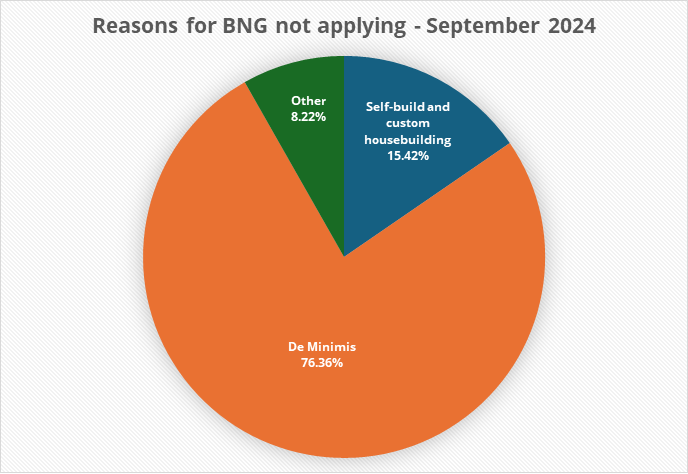
Both these exemptions have specific legislative eligibility criteria. High rates of exemption claiming has prompted us to implement additional logic to ensure they are being correctly used and provide local authorities with clearer information to confirm the validity of any exemption claim.
‘De minimis’ exemption
For this exemption, we are adding a simple question to confirm that the development site that the application pertains to is under or over 25 square metres in size.
If it is over 25 square metres, exemptions can still apply, but we will display additional content recommending that applicants evidence eligibility for the exemption, by providing a completed BNG metric and habitat plans, as these will contain the necessary pre/post development information.
We will also surface a link to our BNG partner Joe’s Blooms online tool, which can assist in producing the relevant evidence where needed.
Self-build and custom housebuilding exemption
There are three eligibility criteria that specify the development must:
- consist of no more than 9 dwellings
- be on a site that has an area no larger than 0.5 hectares
- consist exclusively of dwellings that are self-build or custom housebuilding as defined in section 1(A1) of the Self-build and Custom Housebuilding Act 2015 (as amended).
These will be added as specific questions when the exemption is selected, to ensure applicants are aware of the limitations, and can either:
- clearly state the proposed development’s eligibility; or
- be directed to not use the exemption if these criteria are not met.
We are also adding a question and additional content to remind the applicant to check and confirm if the local authority requires evidence that the development is eligible to be considered as self-build or custom housebuilding.
What this means for applicants and agents
When implemented, the relevant additional questions will need to be answered for the BNG section to be completed.
For existing draft applications, if you have used one of these exemptions, you should go back into the BNG section to answer these additional questions, as all sections will need to be complete before the system will allow you to pay and submit.
If you need to supply additional information to support an exemption claim, this can be added in the supporting documents section.
What this means for local authorities
When implemented, the additional question information will be shown in the generated PDF application forms for every submission.
No BNG data is contained within the XML datafile for the application, but the JSON datafile will contain these additional responses.
Please note: Applications that are already in the process of being paid for and submitted when the change takes place may show the additional questions as ‘incomplete’. This is because the applicant would not have had a chance to answer them before submission occurred. Our service desk can check and confirm this for individual applications if necessary.
To find out more about sustainability initiatives within the built environment, visit our Sustainability Hub.


