The two biggest UK political parties published their 2015 Election manifestos this week with housing supply pledges centre stage from both the Conservatives and Labour.
The former formally committed to 200,000 new starter homes built on brownfield sites by 2020 as well as 275,000 additional affordable homes by the same date.
Labour promised that at least 200,000 new homes a year are built by 2020 and committed to a new generation of garden cities. It also said it would implement all the recommendations of the Lyons Commission.
The Conservatives pledged support for “locally-led garden cities and towns in places where communities want them, such as Ebbsfleet and Bicester. It would also extend right to buy provisions to Houisng Association dwellings.
The manifesto states: “We will fund the replacement of properties sold under the extended Right to Buy by requiring local authorities to manage their housing assets more efficiently, with the most expensive properties sold off and replaced as they fall vacant. We will also create a Brownfield Fund to unlock homes on brownfield land for additional housing.
Its manifesto added: “When new homes are granted planning permission, we will make sure local communities know up-front that necessary infrastructure such as schools and roads will be provided. We will ensure that brownfield land is used as much as possible for new development.
“We will require local authorities to have a register of what is available, and ensure that 90 per cent brownfield sites have planning permission for housing by 2020.”
Much of Conservative manifesto confirmed promises made recently by the Coalition on new road spending, flood protection, new railways particularly in the north of England as part of the Northern Powerhouse initiative and a London Land Commission. Crossrail 2 was formally backed.
Labour is promising to give local communities “more power to shape their high streets, and
so preserve their local identities”. Communities will be able to review betting shop licenses in their area and reduce the number of fixed-odds betting terminals in existing betting shops – or ban them entirely – in response to local concerns.
Labour has also promised an English Devolution Act, handing £30bn of resources and powers English city and county regions and a new Infrastructure Commission to prioritise investment in flood prevention. It has confirmed it backs a “value for money” HS2.
The Conservatives will strengthen the Community Right to Bid regime and promised over the next five years “to put in place stronger protections for our natural landscapes, establish a new Blue Belt to safeguard precious marine habitats, and launch a programme of pocket parks in towns and cities”.
It also confirmed its stance on onshore wind farms which will mean an end to the subsidy regime and a legal change “so that local people have the final say on wind farm applications”.
(We will review the planning-related pledges of other major political parties in subsequent weeks.)
Roger Milne
Construction of examples of National Grid’s new T-pylon has begun at the company’s training academy in Nottinghamshire.
The building of the training line of pylons will be the first opportunity to see the new design in the landscape.
The T-pylon was the winner of an international design competition to look for a 21st century design to carry high voltage overhead lines. The winning design from Bystrup, the Danish architects and engineering company, is 35 metres high – up to one third lower than the conventional steel lattice pylon.
A span of six of the new T-pylons will be built at the training academy. The different pylons all have a different function.
They include the standard suspension pylon that is designed to carry the cables in a straight line. Two suspension pylons will be built at Eakring.
Also in the mix is a D30 pylon which can allow for the greater pressure and weight of turning the cables at an angle of up to 30 degrees.
In addition a F10 flying angle suspension pylon which can allow a turn of up to 10 degrees – the first time such a pylon has been used in the UK- is being set up.
David Wright, director of electricity transmission asset management at National Grid said: “We developed the new style of pylon so that we could have a 21st century design to offer as we plan new transmission routes.
“The T-pylon is not a replacement for the steel lattice pylon but it’s a new option and in some landscapes its shorter height and sleeker appearance can offer real advantages.”
Learn more on the National Grid’s website.
Roger Milne
Glasgow-based Development Finance Ltd has launched a new finance product which is targeting the new permitted development regime in England, which allows the conversion of redundant agricultural buildings into housing without the need for a planning application.
While there are still planning procedures and regulations that must be met, such as noise impact, flooding risks etc, the new regime allows disused buildings of up to 450 square metres to be converted into a maximum of three residential units.
David Levitus, director of Development Finance Ltd explained “we have had an increasing amount of enquiries regarding development funding to convert farm buildings such as barns, sheds and byres which are no longer suited to modern agriculture”.
The company has created a brand new product – Permitted Development Loans. Levitus added: “This type of development finance is pretty specialised so we have launched a bespoke loan package that takes our clients through the lending and development process.”
Under the current arrangements the converted properties must be occupied by 30 May next year.
Development Finance Ltd confirmed it is being approached by increasing numbers of farmers and owners of derelict rural properties. The firm is also prepared to provide advice on reputable builders and development partners.
Roger Milne
Westminster City Council is considering legal action over the demolition of a pub in Maida Vale, west London, that was in line for listing. It was the last building left standing in its street during World War 2 bombings.
The council had rejected plans to pull down the Carlton Tavern in Carlton Vale in January. Developers CLTX Ltd proposed to remove the then existing building and replace it with a ground-floor pub and four upper floors comprising ten residential units.
This proposal was turned down by a planning sub-committee on January 13 because “the bulk, height and detailed design the new building would be detrimental to the view from the adjacent Maida Vale Conservation Area”.
A Westminster City Council spokesperson said: “The building’s demolition required the city council’s prior approval and as no such approval was sought or obtained, the city council will be seeking legal advice concerning whether any future action is legally possible.
“The demolition of the Carlton Tavern remains under active investigation and the council is considering all of its options at this stage.”
Historic England, the government’s heritage advisor, confirmed the pub was being considered for listing.
Westminster councilor Jan Prendergast said: “This came as a shock to everyone. There was no prior warning to the council, no approvals and no proper health and safety procedures in place.”
Roger Milne
Key changes in relation to environmental impact assessments (EIAs) and, separately, s106s and the community infrastructure levy (CIL) have just come into force
An amendment to the Town and Country Planning (Environmental Impact Assessment) Regulations 2011 (‘EIA Regulations’) has raised the threshold for EIA screening and whether an environmental statement will be necessary.
Among the changes, the threshold for industrial estate development projects is raised from areas exceeding 0.5 hectares to areas exceeding five hectares while the threshold for residential development is upped from 0.5 hectares up to five hectares.
However, residential developments of more than 150 units require screening even if they fall below the five hectare mark. Meanwhile, the threshold for other urban development is raised from 0.5 hectares to five hectares.
There is no change over development in sensitive areas like National Parks, Areas of Outstanding Natural Beauty, Special Areas of Conservation, etc.
In the case of the CIL and s106 regimes the Government’s intention is to ensure that the vast majority of planning contributions are paid through the simplified CIL system rather than through individual s106 agreements.
From this month (April) there are restrictions on the pooling of planning obligations. Now, local authorities can no longer pool five s106 obligations together to pay for a single infrastructure project or type of infrastructure.
Roger Milne
Pickles gets tough on housing schemes in Q1 2015
Communities Secretary Eric Pickles has clamped down significantly on permissions for new housing during the first quarter of 2015, according to new research from property consultancy Bilfinger GVA.
This showed that between January and March this year the Secretary of State only allowed two schemes out of the 20 cases he determined.
This analysis indicated that 46 per cent of all Secretary of State refusals since the publication of the National Planning Policy Framework (NPPF) in 2012 were made during the first quarter of this year.
The schemes under consideration during the first quarter 2015 amounted to 9,655 new homes. The two schemes allowed made provision for 454 new dwellings, around five per cent of the total involved in the Pickles decisions.
Of the 18 schemes refused by Pickles, a third had been recommended for permission the inspectors who considered the public inquiries.
Home Counties “Dallas” concerns surface
Campaigners and planning authorities across some of the English Home Counties are bracing themselves for the possibility of a series of major environmental battles after an exploration company announced there could be up to 100 billion barrels of oil onshore beneath the South of England.
That prospect was highlighted by UK Oil & Gas Investments (UKOG) following analysis of a well drilled at Horse Hill, near Gatwick airport. The company suggests the local area could hold 158 million barrels of oil per square mile. However, UKOG acknowledged that only a fraction of the 100 billion total would be recovered.
UKOG’s chief executive Stephen Sanderson said: “We think we’ve found a very significant discovery here, probably the largest [onshore in the UK] in the last 30 years, and we think it has national significance.”
UKOG said the majority of the oil lay within the Upper Jurassic Kimmeridge formation at a depth of between 762 and 914 metres.
The company said further drilling and well testing would be needed to prove the initial results.
NPPF thumbs-down from developers
Developers believe the National Planning Policy Framework (NPPF) published three years ago has failed to improve the planning process, a new survey has found.
A survey of 49 chief executives and directors from developers and housing associations found that 52 per cent felt it has made no difference, 19 per cent said it inhibited homebuilding and 29 per cent believed it was helping.
The survey, by accountancy and business advisory firm BDO, also found that respondents saw the planning system as the biggest obstacle to building enough homes to meet demand.
In addition 94 per cent of those surveyed thought that reaching the Government target of 245,000 new homes per annum in the next two years was unrealistic.
Cheshire East buys more time for housing assessment
The planning inspector examining Cheshire East Council’s local plan has given the planning authority until the end of July to submit additional evidence on how it has assessed and how it will meet housing need in its area including in cooperation with neighbouring authorities.
Heritage concerns sees off north London homes
A planning inspector has dismissed an appeal by developer Fairview New Homes for a proposed development in north London over the adverse impact on heritage assets and the character of the surrounding area.
The proposed development involved the demolition of a pub which had been registered by Brent Council as an Asset of Community value (ACV) located in a conservation area.
The developer’s proposal was to erect a new tower, six to 10 storeys high which would include 53 apartments, a replacement pub and community uses.
London round-up
- Waltham Forest Council has finalised plans to build 2,000 new homes in five years in partnership with housing associations and private developers. This will include 50 per cent affordable housing and the creation of higher density, mixed communities. Of the 1,000 affordable homes, 400 will be at social rent level with the remaining 600 being a mixture of shared ownership and affordable rent.
- A joint report published by business body London First and law firm Berwin Leighton Paisner, London First has published a report which makes the case for legislation requiring all public bodies including councils to maintain an accurate, legible and searchable pan-London register of their land assets.
- A study by estate agent Stirling Ackroyd, which analysed all planning applications received and granted in London in 2014 and concluded that only 27,470 new homes were granted planning permission in the capital last year. The study also said that at this rate London would only achieve 65 per cent of the conurbation’s target under the London Plan.
- Hackney Council is east London has begun consultations on new conservation area proposals for Dalston town centre centred on Kingsland High Street and the extension of the existing Albion Square Conservation Area.
Green light for Hemel flats
Proposals for 207 flats, a third of which will be affordable, in the heart of Hemel Hempstead overlooking the River Gade have been given the green light by Dacorum Borough Council’s development control committee.
The development will form part of the regeneration plans taking place in the Gade Zone area of the town under an agreement between Dacorum Borough Council and its private sector partners – Endurance Estates and RG Carter.
Lake District mountain deal back in prospect
A community group that failed to buy a Lake District fell put up for sale last year has revealed that it is back in negotiation with landowner the Earl of Lonsdale over the purchase of Blencathra Mountain which had a price-tag of around £1.7m.
The group, called the Friends of Blencathra, reported that the Earl was now willing “in principle” to proceed to the next stage of a sale to the group.
Gravesham Borough Council has given the go-ahead for the redevelopment of South Ebbsfleet United’s football team’s stadium at Northfleet which is now part of the area administered by the recently established Ebbsfleet Devlopment Corporation.
Ambitious plans to modernise the National Zoo of Wales at Colwyn Bay in north Wales have been approved by Conwy Council. The zoo wants to build an alligator beach and tropical rainforest area as part of the Here Be Dragons! project. Also involved in the £6m makeover are proposals for a new world-class education centre.
Go-ahead for north east England tourism and culture projects
A multi-million pound project to help turn Auckland Castle into a major tourist attraction has been given the green light by Durham Council.
The £17m proposal to develop the castle will feature a two-storey annexe containing a museum which will house a 5,000 Years of Faith display, which will chart the history of the British Isles through faith and religion.
Meanwhile, details of a restoration of Middlesbrough’s 126-year-old town hall costing nearly £8m have been revealed.
The project will see parts of the Grade II listed building reopened to the public, including the Victorian courtroom, cells and fire station.
Plans also include a bar, restaurant with a glass atrium and a new community area, as well external lighting to illuminate the building at night.
Major homes project mooted for Northallerton
The developers behind a major new scheme for north Northallerton involving some 900 new homes have begun to consult on the scheme which also includes a new link road and bridge over the railway line.
Mulberry Homes, Persimmon Homes and Taylor Wimpey are conducting the consultation exercise before submitting a planning application to Hambleton District Council.
Student accommodation mooted for Shrewsbury prison makeover
Former prison cells could be turned into accommodation for 200 students under developers’ plans for HMP Shrewsbury, also known as The Dana, which was closed by the Ministry of Justice in March 2013 as part of plans to save £63m.
The Grade II-listed building was bought by the Trevor Osborne Property Group last year. It was responsible for turning Oxford prison into a hotel.
Plans for the prison, which dates back to 1877, also include offices and other accommodation on the three-acre, town centre site. Any proposals would still require planning permission.
The former prison’s future as possible student flats follows the creation of a new campus in the town last year.
University Centre Shrewsbury, set up in partnership with the University of Chester, is expected to welcome its first undergraduates in September.
Devon DIY homes
A group of Devon villagers have started building their own affordable “eco-homes”. Six detached houses with three or four bedrooms are being built in Broadhempston, near Totnes, by local families and couples.
The Broadhempston Community Land Trust was set up four years ago to enable local residents in need of housing to self-build affordable homes. The properties will be solar-heated and insulated with straw.
Legal round-up
- Wheelchair-bound Nick Allen has lost his High Court battle with Wiltshire Council to keep his disabled-friendly music studio open. He has now been ordered to demolish it by September. He had planning permission to rebuild a storage barn in Holt near Bradford on Avon, but it did not include conversion into a recording studio.
- The London Borough of Ealing has secured a £66,000 confiscation order against an individual who converted a property into three flats without planning permission in 2010. The west London local authority prosecuted Dragan Milinkovic, who owned the house in Cuckoo Dene, Hanwell, for failing to comply with an enforcement notice. As well as the confiscation order, Judge Donne QC at Harrow Crown Court fined Milinkovic £2,700 and ordered him to pay Ealing’s costs of £4,762 plus a victim surcharge.
Roger Milne
You may be aware there have been a few policy changes announced recently that came into effect today (Wednesday 15 April 2015).
Quite a major change will see the consolidation of the Town and Country Planning (General Permitted Development) Order 1995 and the Town and Country Planning (Development Management Procedure) (England) Order 2010 – both have been amended a huge number of times since they were introduced.
These have been consolidated in the guise of the:
Town and Country Planning (General Permitted Development) (England) Order 2015.
Town and Country Planning (Development Management Procedure) (England) Order 2015.
To cater for the change we have updated our suite of 1APP forms with the new legislative titles.
Coupled with this the Government has introduced many new permitted development changes which can be found in the attached explanatory memorandum.
We have updated the site guidance to reflect the new changes. Updating the interactive guides will be completed shortly.
On evaluating the policy there will be new permitted development rights subject to a prior approval process for many of the changes.
In light of this we shall facilitate a standard approach on the Planning Portal by creating new prior notification forms. We have created drafts and sent them to a LPA quality assurance group to ensure they contain all the correct information required by legislation for them to be processed quickly and efficiently.
We are currently updating them to incorporate the feedback received and they should be in place by the end of this week.
We’d like to thank Medway, Salford, South Derby, Tunbridge Wells and Wandsworth councils for helping review these new forms.
The policy change will see new forms for:
- A new permitted development right, for a three year period, will allow storage or distribution buildings (B8) to change use to residential (C3).
- A new permitted development right will allow amusement arcades/centres and casinos, (sui generis uses) to residential (C3) use and carry out associated building works that are reasonably necessary to make this change.
- A new permitted development right to allow the change of use from shops (A1), financial and professional services (A2), betting offices, pay day loan shops and casinos to restaurants and cafés (A3)
- A new permitted development right to allow the change of use from shops (A1) and financial and professional services (A2) to assembly and leisure uses (D2), with an upper threshold of 200m2 of total floor space.
- A new permitted development right to allow retailers to erect click and collect facilities within the curtilage of their existing shop, for example, on car parks.
- A new permitted development right will allow for temporary filming and the associated operational development for the sole purpose of commercial filmmaking.
- A new permitted development right which will apply to the installation, alteration or replacement of Solar Photovoltaics (PV) on the roofs of nondomestic buildings, up to a capacity of 1 Megawatt, subject to certain limitations.
Please note that the new prior notification forms will not be available on the online application system, fee calculator or paper form chooser. This means that the forms below do not currently carry specific LPA details or branding.
Following their introduction by the end of this week we shall make them available on the Portal’s PDF forms page. I’ll blog again when they are live.
We anticipate that following the transition to a new Planning Portal IT infrastructure, we may be able to accommodate the new and existing prior notification forms into the full suite of 1APP online forms and more will follow on this in the coming months.
The application numbers for March are now in. It looks you’ve been busy again as it was a bumper month for applications – up 22% on last March at 46,739!
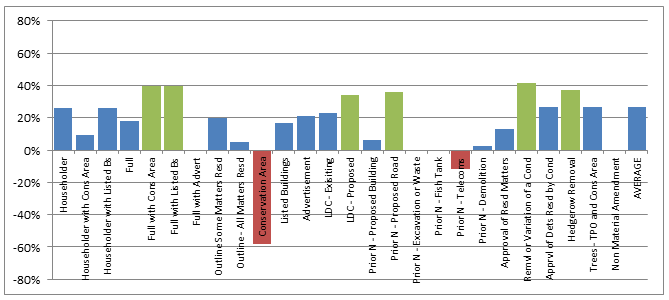
That brings the total for the financial year 2014/15 to a whopping 458,276 applications. Below you can see the increases (and in some cases decreases) of all the application types that can currently be submit through the Planning Portal from 2013/14 to 2014/15 as a whole.
Some types of application (shown in green) outperformed the average yearly increase, in particular “Full With Conservation Area”, “Full with Listed Buildings” and “Removal or Variation of a Condition” at around a 40% increase. The falls we saw were either down to policy changes (affecting Conservation Area) or change in business practices (some Prior Notifications).
You can click the image below to expand it.
Local plan progress over the last three years since the National Planning Policy Framework (NPPF) was published has been “marginal”, according to an assessment by Nathaniel Lichfield & Partners.
The consultancy pointed out that only a quarter of English local authorities have a NPPF-compliant up-to-date adopted plan.
Around a fifth have a plan submitted and an examination underway or forthcoming. Some 62 plans have been found sound. But 21 have been withdrawn because of concerns over soundness while 32 per cent of adopted plans require an immediate or early review.
The report: ‘Signal Failure: A Review Of Local Plans And Housing Requirement’ highlighted that the Planning Policy Guidance launched in March 2014 was not being applied consistently.
The authors of the report stressed that “plans are not yet dealing effectively with ‘overspill’ issues, particularly from urban areas.
“This is the next major hurdle for plan-makers: even where the scale of unmet need is known (as with London and Birmingham), there is limited evidence of plans or inspectors answering vital questions over how the overspill is distributed to surrounding locations.”
On average it now takes five months longer for plans to be found sound after being submitted than it did before the NPPF was introduced.
Particular problems noted by the research included identifying which neighbouring authorities will be asked to meet the housing overspill that cannot be accommodated by the council itself.
Also looming large was the fact that authorities constrained by large green belts appeared to be dragging their feet over housing requirements in their plans.
Read the report on the Nathaniel Lichfield & Partners website.
Roger Milne
Communities Secretary Eric Pickles has intervened directly over the level of housing that North Somerset District Council is being expected to provide in its core strategy.
The Secretary of State has taken the unprecedented step of announcing he will look at the housing provision required by the planning inspector who handled the core strategy examination.
The Secretary of State noted that the strategy has “undergone a complex and protracted examination at a time of transition in national planning policy”.
He added: “I wish to review and consider the inspector’s conclusions on Policy CS13 Housing Requirement to ensure national policy has been applied and reflected correctly. I wish to ensure that there is maximum clarity for the community on the outcome of the examination.”
North Somerset originally adopted the strategy in April 2012 with a housing policy to plan for 14,000 houses. Following a legal challenge, the policy was found to be unlawful on the grounds that the independent planning inspector had failed to give adequate and intelligible reasons for his support of the council’s housing requirement.
The plan was then referred back to PINS and, despite the council agreeing in the meantime to increase the number to 17,000, a further examination resulted in a new inspector concluding that 17,000 houses was still insufficient to meet the council’s needs.
Instead, the inspector confirmed a housing figure of 20,985 – a 50 per cent increase on the council’s original number. Two local MPs and the planning authority wrote to the Secretary of State asking him to review the housing figure
David Turner, director of development and environment for the council, said: “We have been working hard with the Planning Inspectorate to reach a deliverable approach to balancing future housing needs while respecting the considerable environmental constraints, including green belt, that define our area.
“It is gratifying that the Secretary of State acknowledges the unique set of circumstances that have prevented us from having an adopted plan, and that he considers it necessary to review the inspector’s conclusions.”
In the meantime the council will use the evidence it has prepared through the examination process to decide planning applications for new housing development and will continue to resist inappropriate development proposals that would damage the environment of North Somerset.
Roger Milne


 Planning Portal Blog